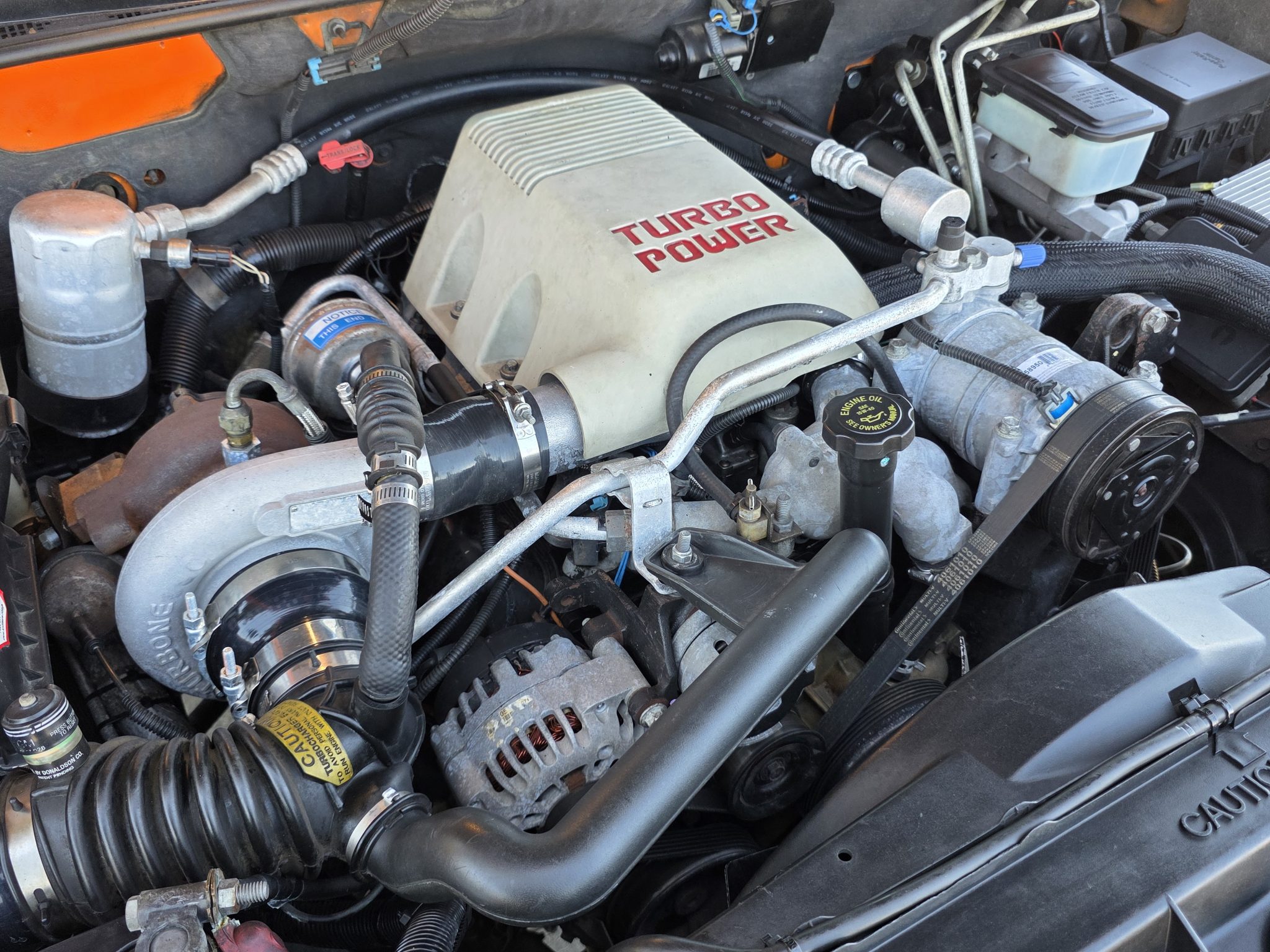
The Detroit Diesel 6.5L Turbo Diesel (RPO: L65 and L56) was GM’s primary light-duty diesel engine throughout the GMT400 era. Introduced in 1992 as an evolution of the earlier 6.2L diesel, the 6.5L added displacement and turbocharging to improve power, drivability, and towing performance.
While it was never intended to compete directly with heavy-duty inline-six diesels, the 6.5L filled an important role in GM’s truck lineup by offering improved fuel economy and strong low-end torque in a familiar V8 package.
History and Development
The 6.5L Turbo Diesel traces its roots back to the 6.2L Detroit Diesel introduced in the early 1980s. That engine was designed during a period of rising fuel economy demands and was intended to provide diesel efficiency in a light-duty platform.
By the early 1990s, GM increased the bore of the 6.2L to create the 6.5L, raising displacement to 395 cubic inches. Early versions were available with mechanical DB2 injection pumps, and turbocharged variants quickly became the standard in GMT400 trucks.
In 1994, the engine received one of its most significant updates with the introduction of the electronically controlled DS4 injection pump. This improved emissions control and drivability, but also introduced additional electronic complexity, including the now well-known PMD module.
Throughout its production, the 6.5L saw a number of incremental improvements aimed at addressing cooling and durability concerns. Early engines were known to struggle with heat management under heavy load, particularly in towing applications.
By 1997, GM introduced a revised cooling system that included a high-output water pump, dual-thermostat crossover, and an improved 9-blade composite cooling fan paired with a severe-duty fan clutch. These updates significantly improved airflow and coolant circulation, helping reduce operating temperatures and increasing reliability under sustained load.
Additional refinements over the years included updates to the turbocharger control system, improvements to block casting strength, and calibration changes to balance performance, emissions, and longevity. Despite these updates, the core architecture of the engine remained largely unchanged from its 6.2L origins.
Production of the 6.5L Turbo Diesel continued through the end of the GMT400 platform in 2000 (and into 2002 for vans and some applications), after which it was replaced by the Duramax 6.6L — a completely new, clean-sheet diesel design.
Design and Architecture
The 6.5L is a 90-degree V8 diesel with a cast iron block and cylinder heads. Unlike modern diesel engines, it uses an indirect injection (IDI) system with pre-combustion chambers located in the cylinder heads.
Fuel delivery is handled by a rotary injection pump (DB2 or DS4 depending on year), feeding mechanical pop-style injectors. Turbocharged variants use a single turbocharger with vacuum-controlled wastegate in most applications.
The engine was designed for durability and efficiency rather than high performance, with a heavy rotating assembly and conservative operating speeds. This results in strong low-end torque and predictable behavior under load.
Horsepower and Torque Ratings
Output for the 6.5L Turbo Diesel varied slightly depending on year, calibration, and application.
- 1992–1993 (DB2 mechanical): ~180 hp / 360 lb-ft
- 1994–1995 (early DS4): ~190 hp / 385 lb-ft
- 1996–2000 (L65/L56): 190–195 hp / 385 lb-ft
- 2001–2002: ~190 hp / 380 lb-ft
While these numbers are modest compared to gasoline engines, the 6.5L delivers its torque at low RPM, making it well-suited for towing and highway driving.
L65 vs L56 — What’s the Difference?
The 6.5L Turbo Diesel was offered in two primary variants during the GMT400 years: L65 and L56. Both share the same base engine, with differences focused on emissions equipment.
L65 (Light Duty Turbo Diesel)
- No EGR system
- Simpler intake and vacuum routing
- Fewer components and generally more reliable
- Common in ¾-ton and 1-ton trucks
L56 (EGR-Equipped Turbo Diesel)
- Equipped with EGR (Exhaust Gas Recirculation)
- Additional intake and vacuum components
- Typically found in ½-ton trucks and SUVs
- Designed to meet stricter emissions standards
Key Differences
| Feature | L65 | L56 |
|---|---|---|
| EGR | No | Yes |
| Complexity | Lower | Higher |
| Reliability | Higher | Slightly lower |
| Applications | ¾-ton / 1-ton | ½-ton / SUVs |
How to Identify L65 vs L56
- EGR Valve: Present = L56, Absent = L65
- Intake Plenum: L56 includes EGR routing
- Vacuum Lines: L56 has additional controls
- Emissions Label: Often indicates EGR
Injection Pump Differences (DB2 vs DS4)
DB2 (1992–1993)
- Fully mechanical injection pump
- No PCM required
- No PMD
- Very reliable and simple
DS4 (1994–2002)
- Electronically controlled injection pump
- PCM-controlled fuel delivery
- More precise operation
- Subject to PMD failure
| Feature | DB2 | DS4 |
|---|---|---|
| Control | Mechanical | Electronic |
| Years | 1992–1993 | 1994–2002 |
| Reliability | High | Good (with PMD fix) |
| Complexity | Low | Higher |
Common Upgrades and Reliability Improvements
- PMD Relocation: Essential for DS4 reliability
- Cooling Upgrades: High-output pump, dual thermostats, improved fan
- Turbo Control: Mechanical wastegate controllers improve consistency
- Exhaust Improvements: Reduce EGTs and improve efficiency
- Electrical Maintenance: Strong grounds and charging system are critical
6.5L Turbo Diesel Specifications (L65)
| Basic Description | |
| Displacement | 6.5L (395ci) |
| Bore | 4.06in |
| Stroke | 3.82in |
| Compression Ratio | 21.3 : 1 |
| Firing Order | 1-8-7-2-6-5-4-3 |
| SAE Net Horsepower @ RPM | 190 @ 3400 |
| SAE Net Torque @ RPM | 385 @ 1800 |
| Intake System | |
| Induction | Turbocharged, indirect injection |
| Fuel Injectors | Mechanical pop injectors (DS4 electronic pump) |
| Camshaft | |
| Intake Duration | 196 @ .050 |
| Intake Lift | 0.410″ |
| Exhaust Duration | 206 @ .050 |
| Exhaust List | 0.423″ |
| Lobe Seperation | 109 degrees |
| Valvetrain | |
| Туре | Nonadjustable, push rod actuated |
| Lifters | Hydraulic |
| Rocker Arm Ratio | 1.5:1 |
| Cylinder Heads | |
| Туре | Cast Iron Diesel |
| Chamber Volume | Pre-cup indirect injection |
| Intake Volume | N/A |
| Intake Valve Diameter | 1.94in |
| Exhaust Volume | N/A |
| Exhaust Valve Diameter | 1.60in |
| Head Flow Chart | |
| Lift | CFM (I/E) |
| .100 | N/A |
| .200 | N/A |
| .300 | N/A |
| .400 | N/A |
| .500 | N/A |
| .600 | N/A |
Conclusion
The 6.5L Turbo Diesel occupies a unique place in GMT400 history. It was never the most powerful option, and it doesn’t match the capabilities of the Duramax that followed, but it delivered something different: a simple, relatively efficient diesel in a familiar V8 package.
With its roots in the earlier 6.2L, the 6.5L retained a straightforward design that makes it approachable for owners who prefer mechanical simplicity over modern complexity. At the same time, later updates such as the DS4 injection system and improved cooling components helped bring the engine in line with the demands of the late 1990s.
Like the gasoline engines offered in the GMT400 platform, the 6.5L has its known weaknesses — particularly around heat management and electronics — but most of these issues are well understood and can be addressed with proven upgrades.
For those willing to maintain and improve it, the 6.5L Turbo Diesel remains a capable and efficient workhorse that fits naturally within the GMT400 platform.
